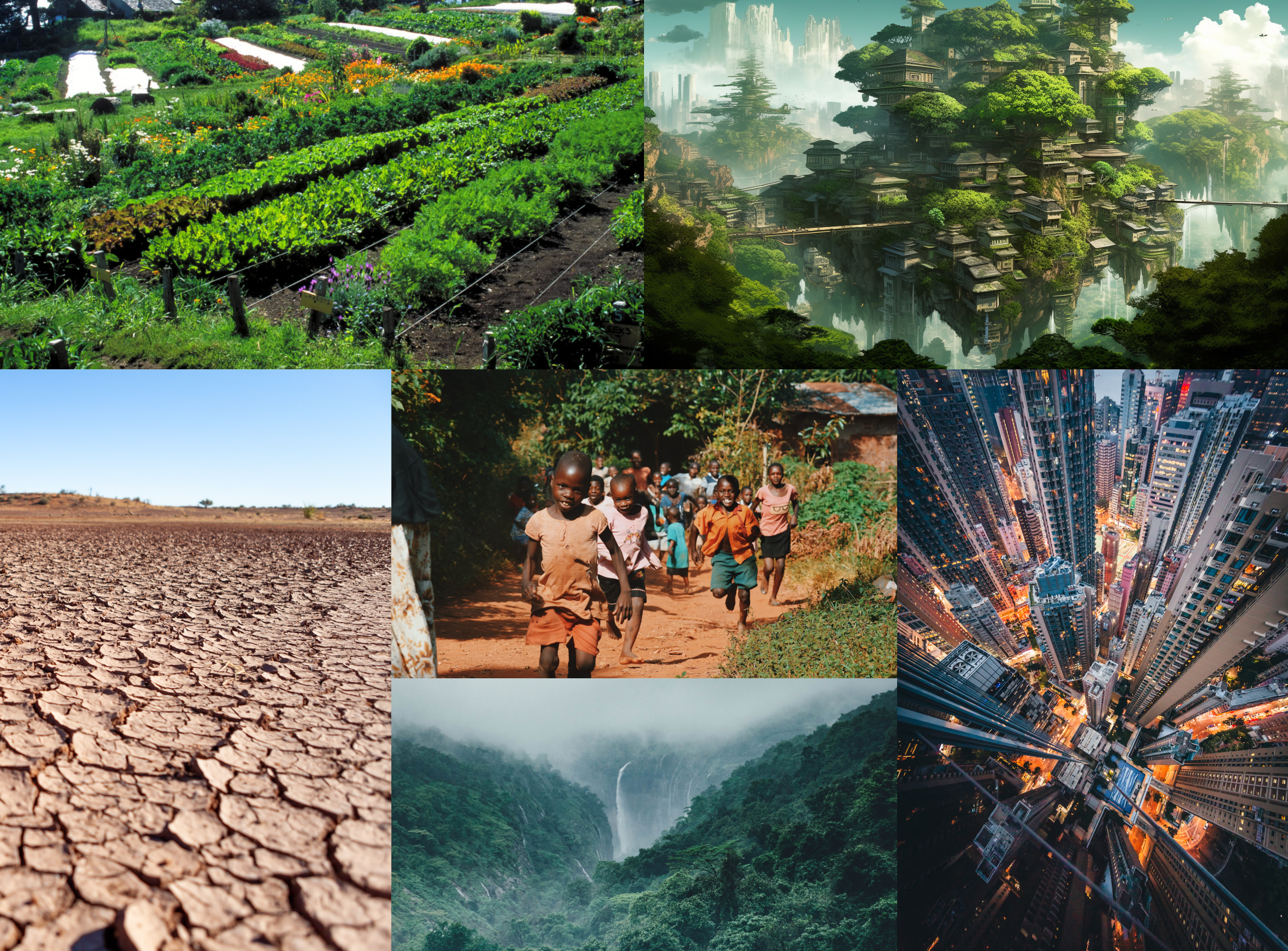
‘Permaculture’ (cropped) from http://localorg.blogspot.com/2014/03/permaculture-healthy-sustainable.html, Green utopia – AdobeStock 609282751, City from above – Simon Zhu on Unsplash ref. 1062654, Rainforest – Atharva Tulsi on Unsplash ref. 784028 (cropped), Desertification – AdobeStock 355637692 (cropped), African children – Seth Doyle on Unsplash ref. 78210.
This background section reflects a personal sustainability journey that started in 2005. This page has only been included here because future website content will touch on broader aspects of that sustainability journey. Hopefully something here resonates with you.
What can you say about the big picture around sustainability? It’s everyone’s business and nobody’s business. We have to do better than business as usual.
Table of Contents
Time out
This is an informal website. After hours. Off duty. Time-out.
Imagine that you’ve just climbed up a mountain with friends, and you’re dangling your feet over the edge and enjoying the view. It’s a beautiful and elevated time. All of civilisation is somewhere down below and you might naturally find yourselves talking about big ideas in a more free and open way. In that spirit, this website will take an informal look at the broader picture around sustainability, rather than concentrating on everyday concerns. Take a little time out?
There’s something wrong with the big-picture. We’re bringing about our own destruction by destroying the Earth’s natural systems, and these are crucial years if we hope to turn it around without diminishing the biosphere and disrupting the climate too much. So, how’s that going? It’s not my area of expertise, but it doesn’t seem to be going very well overall, in terms of the protection and regeneration of ecosystems, and for global sustainability outcomes more generally. This is in no way a criticism of the countless talented and committed people working on environmental and sustainability issues around the world, who deserve our respect and support.
I’m not an ecologist, climate scientist, or environmental expert. I come from a can-do technology background and spent several years working in sustainability-related roles, and many years exploring sustainability issues in Perth and Melbourne, Australia. I’ve been fascinated by it all and was privileged to meet people from vibrant communities in the environmental, sustainability, and social justice spaces. This included people from not-for-profits, industry, academia, government, activists, intentional communities, and just people on the street—inspirational people of all ages.
While my background’s more aligned with discussing technical solutions, on this informal website I’ll also take an interest in what people say about sustainability, the solutions they propose, and the actions they take. It’s interesting to try to distinguish between the positions and assumptions of different people, with their different worldviews.
The website comes from a hopeful and loving place that some people would call naive, exploring where it might get you if you imagine that:
- If we change what we’re doing, we can achieve a wonderful sustainable future for all people on Earth.
- Even if you don’t expect people to be able/willing to bring about your ideal vision of the future, it’s still worthwhile trying to achieve a more sustainable future.
- If you could live so that the overall impact of your lifetime on Earth was to leave more resilient ecosystems and a safer climate, it should increase the likelihood of overcoming collective existential threats, increasing the chances of building up flourishing, fulfilling, amazing futures for countless people and other living beings, in countless ways.
If you were being critical of the very idea of this kind of hopefulness, you’d still have to admit that you can’t prove that it’s impossible to help people in the future by preserving ecosystems and a safe climate today. But by destroying ecosystem resilience today, and bringing on disruptive climate change, it seems likely that you’d be making life for future people more precarious, diminished, impoverished, and maybe even be pushing us towards an early extinction.
When it comes to options for collectively reducing environmental impacts, it’s a pretty safe bet that the disinformation and fearmongering (that we see) will be ramped up in the future. We don’t need authoritarianism and neo-feudalism to reduce our collective environmental impacts, to protect the biosphere. Whatever else we need, we could use more people-and-planet-loving environmentalists. Share the love 🌻
When you grow up with the assumption that people are capable of seeing what’s wrong, and also capable of doing something about it collectively, and even potentially willing to do something about it collectively, it’s painful to see our collective actions around environmental crises playing out as if we’re pretending that:
– Noone knew it needed fixing, so we waited for others to take on the challenge in the future, leaving them with a diminished capacity to take on a tougher challenge.
– We didn’t know what we were stealing from the future.
Real, deep, sustainability enquiries lead to places that fundamentally challenge our cultural understandings, religious teachings, many of our lived experiences, and the dreams and visions of the future we were raised on. It’s not everybody’s idea of a good time.
When I say we, I could only hope to represent a fraction of the population, the same as for anybody else. I don’t claim to speak for you or mean to trivialise your perspective. As we’re all limited by our own perspectives on the world, the website will aim to take an interest in the ideas of people from other kinds of backgrounds: where do they see things heading, and what do they see as their place in it?
When you start talking about the substance of sustainability issues, people will tend to ‘code’ you as belonging to one ‘team’ or another. I’d hope that when you’re exploring sustainability issues, you feel free to question the ideas and assumptions of people coming from every different background and perspective. The website will consistently show respect for people from all backgrounds.
People have all kinds of different beliefs, but we’re still very much tethered to ecological reality; we’re all the Earth’s people, you could say. For now, the hope that future generations will live secure and enjoyable lives of abundance relies on healthy ecological foundations as a core basis of this, as it always has done. So, pushing for ecological sustainability is pro-people, and maintaining a safe climate is pro-people: they’re two sides of the same coin.
Of course, you’ll make your own interpretations. What do you think?
What do people say about whether we can collectively achieve ecological sustainability?
Who’s welcome in the vision of the future promoted by your words and actions?
Is ecological sustainability key to humane visions of the future? 🌱🌎
Adobe Stock 530758046
Playing by different rules
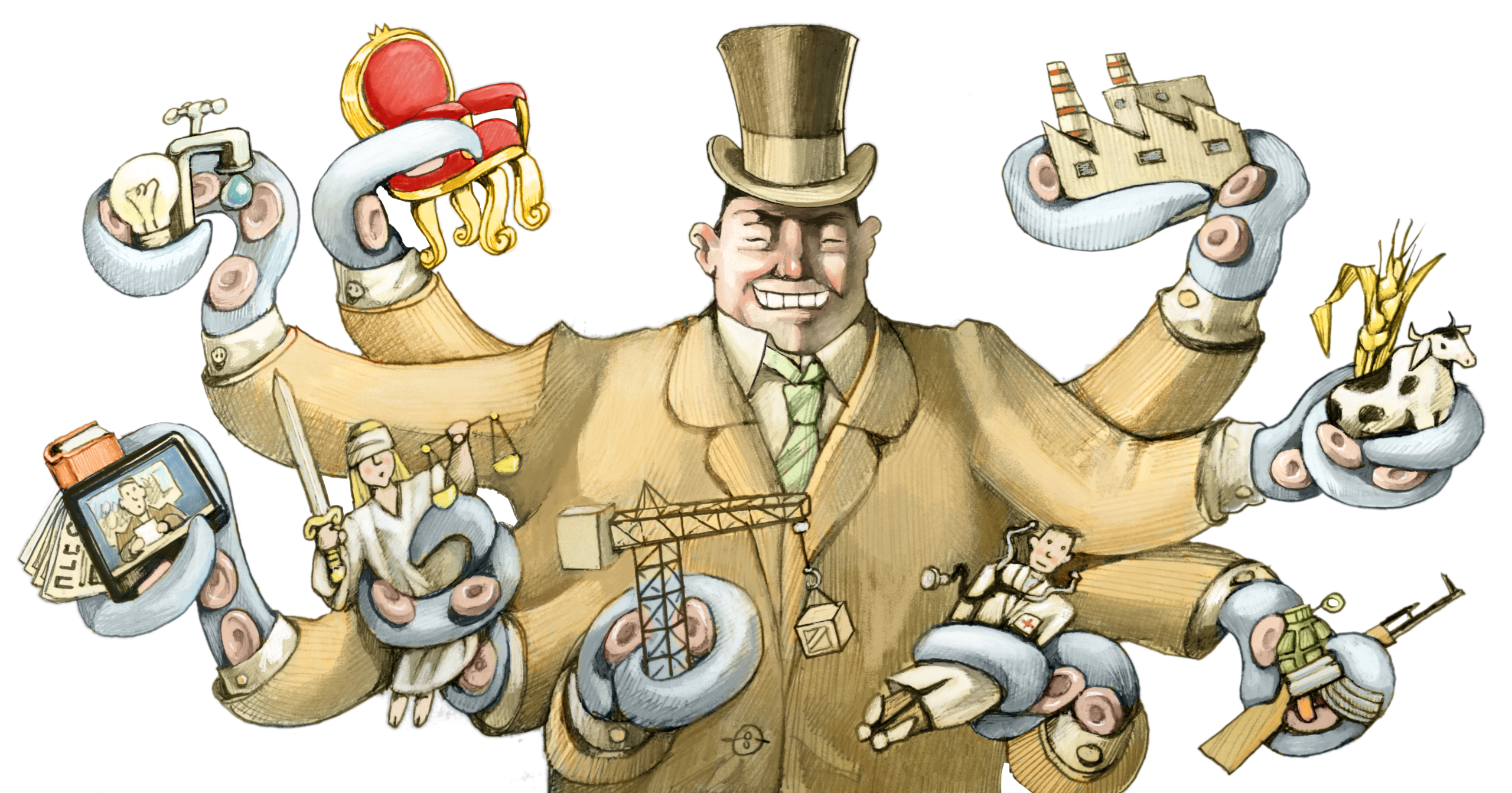
Most people are fundamentally decent and they’re just trying to make their way in the world. As always, some people see ecological systems and people as resources to be exploited—they’re not playing by the same rules. The website will explore what people from very different backgrounds and perspectives say (and do) about sustainability issues.
At the same time, decent people all over the world, embedded in unsustainable systems, just trying to live our best lives, are indirectly acting as if ecological systems and people are just resources to be exploited, through the effects of our actions in modern industrial and information societies. It’s these unsustainable systems that you’d hope could be reformed, redesigned, recalibrated, replaced, transcended, to allow us to live our best lives, within our societies, and be truly environmentally sustainable.
Adobe Stock 121027195
Earth’s been good to us

Source: Fig. A, Millennium Ecosystem Assessment, Ecosystems and Human Well-being: Synthesis (2005)
Ideal-world sustainability aspirations in 2007
When I learnt about the real seriousness of climate change and ecological destruction at the start of 2005, I hadn’t studied political science, or history, or other relevant social sciences. I assumed at that time (like a lot of people), that the people in charge would eventually listen to the science and somehow put effective programs in place to solve the problems. Or, at least, I assumed that we could do things every day to improve the prospects of a more prosperous and safe future, though the outcomes couldn’t be guaranteed in advance of course. I decided that I’d try to be part of the solution and I met a lot of other people with similar ideas.
We can celebrate and enjoy life while tackling the systemic issues that threaten our future
I went back to university in 2007 to study energy and sustainability and am grateful to have found an energy studies course with the principles of ecologically sustainable development as an explicit foundation Jennings & Lund (1999) Renewable energy education for sustainable development.
When I first studied sustainability, I was impressed by the nested sustainability diagram (below). We depend on ecological sustainability as a core basis for our security, freedom, and prosperity.

Source: https://en.wikipedia.org/wiki/Sustainability#/media/File:Nested_sustainability-v2.svg KTucker, CC BY-SA 3.0 , via Wikimedia Commons
The list of ideal-world big-picture sustainability aspirations below crystallised for me in 2007. I spent a lot of time on campus and made friends in environmental science (and energy studies). I also studied some units at the old sustainability school at Murdoch University in Perth, Australia, including the mind-blowing unit Policy, Technology, Democracy. As a non-ecologist, the requirement for an idealised transition to ecological sustainability seemed to suggest the need for some major transformations:
- Managing the global water cycle in harmony with the biosphere
- Healthy living soils: organic farming scaled up to feed the world
- Ecological economics: circular economy, steady-state economics, etc. “The economy is a wholly owned subsidiary of the environment, not the reverse” Herman E. Daly
- Sourcing the total primary energy supply from close to 100% renewable energy
- Restoring a safe balance in the global carbon cycle, and for other greenhouse gases, and for other biogeochemical cycles.
- Inclusion, diversity, equity, women’s empowerment, reduced income inequality, and generally tackling systemic oppression.
- Humanely managing population – facilitated by empowering women and enabling family planning.
- Large-scale reforestation and the restoration of healthy ecosystems and wild places
- Sustainable cities
- etc.
They’re all old ideas of course, and noble ideal-world aspirations when viewed in the humane and reasonable ways that they were intended, but whether they could all be feasible in the real world is another matter.

Adobe Stock 945657457
A sustainability landscape
If sustainability ideas were mapped out like a landscape, it’d be a vast and unexplored land for many of us. And if sustainability ideas were mapped out like a landscape, the mainstream sustainability maps mightn’t even include major features of the landscape. This website aims to provide glimpses of some of the lay of the land, quickly and easily, and in simple language.
Sometimes an image or a chart speaks for itself. Happy hiking!
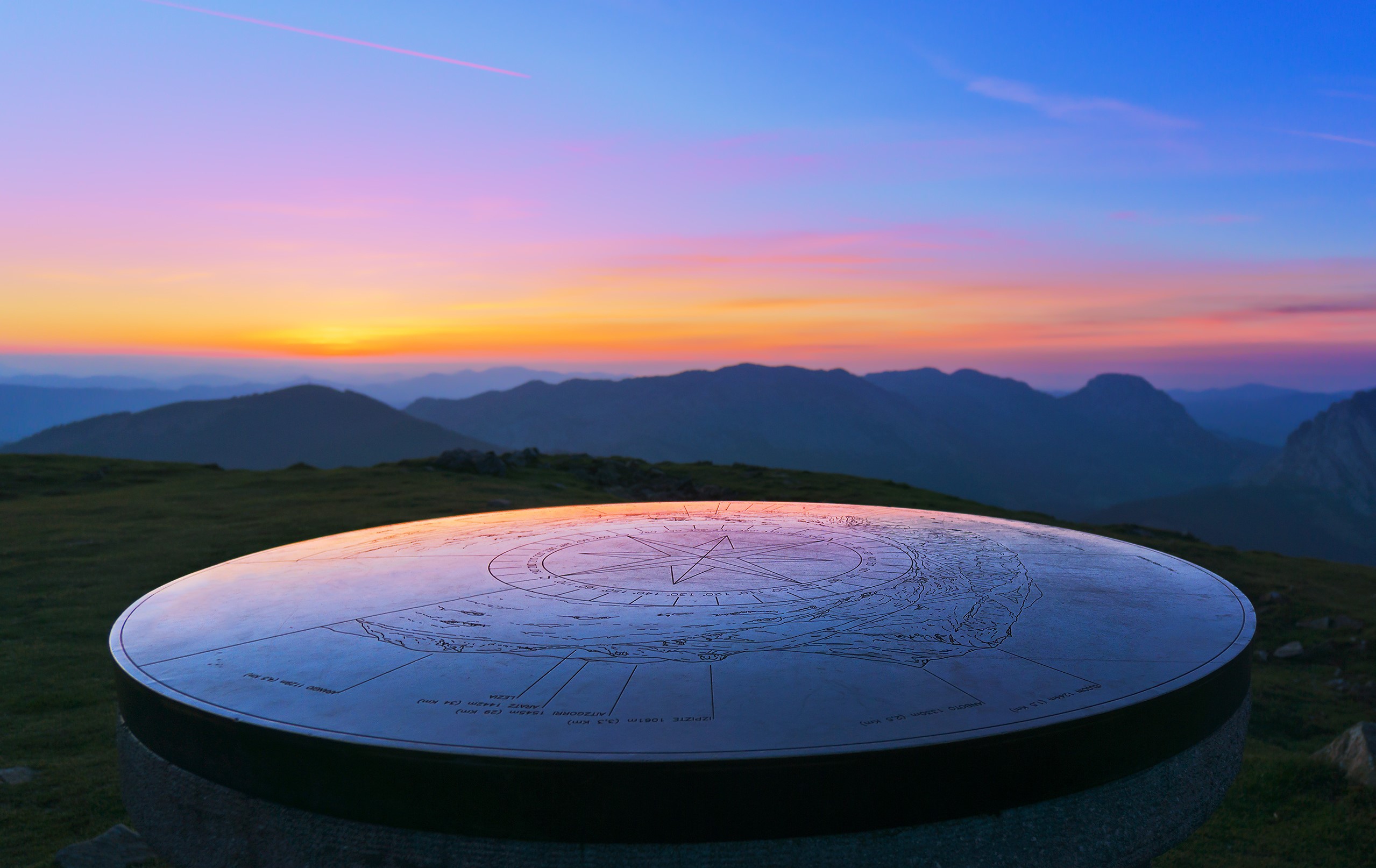
Toposcope in Urkiolamendi
Adobe Stock 81663770
Original website
Why the site was created in the first place:
- I was going to write in-depth sustainability-related articles and publish them elsewhere, then use this website to feature the same articles, along with additional resources. Life got in the way, and my focus shifted.
- I also planned to share links to a wide range of sustainability-related articles from all over the world using a tag system (inspired by the del.icio.us website circa 2007) to help share content to counter disinformation. Many of those articles are no longer available to access for free, as they’re now sitting behind paywalls.
As you may remember, for several years many of the best newspapers and magazines around the world provided free, legal online access to a huge number of excellent articles from their archives. It’s almost hard to believe now that this was true so recently. Over several years I’d collected links to a wide range of environmental and sustainability articles to share online but hadn’t shared them. These articles were fantastic to link to when trying to counter disinformation in online forums, such as in the comments section following online articles, and in social media. At that time, you could often share links with your comment following a newspaper or magazine article online for example. And a wide range of opinions remained visible in those online comment sections. Whereas today many of the same publications only seem to display comments that agree with their editorial line, avoiding any real debate. That all changed very quickly, and by the time this website started, many of those articles were only available behind paywalls. It’s perfectly understandable that they chose to monetise their archived articles.
The site today:
- I’ll generally avoid sharing a link to an article that the public can’t access without paying for a subscription. This is because if I share a link to a new article that The Ecologist magazine allows to be shared freely online while it’s new, I can’t expect that link to provide access in the future when it becomes archived behind their paywall (which goes without saying nowadays).
- I haven’t activated comments on the website for now because, although I’d welcome a diversity of opinions, I don’t have time to properly moderate bad faith misrepresentations of the facts, etc.
- This self-hosted WordPress website uses the Customizr theme, set up for a simple retro feel.
Whatever your background, I hope you’ll find something of interest.
Cheers,
Sean Frost
Email: info@ecorealities.com
Adobe Stock 559960458