Renewable Energy

1 post

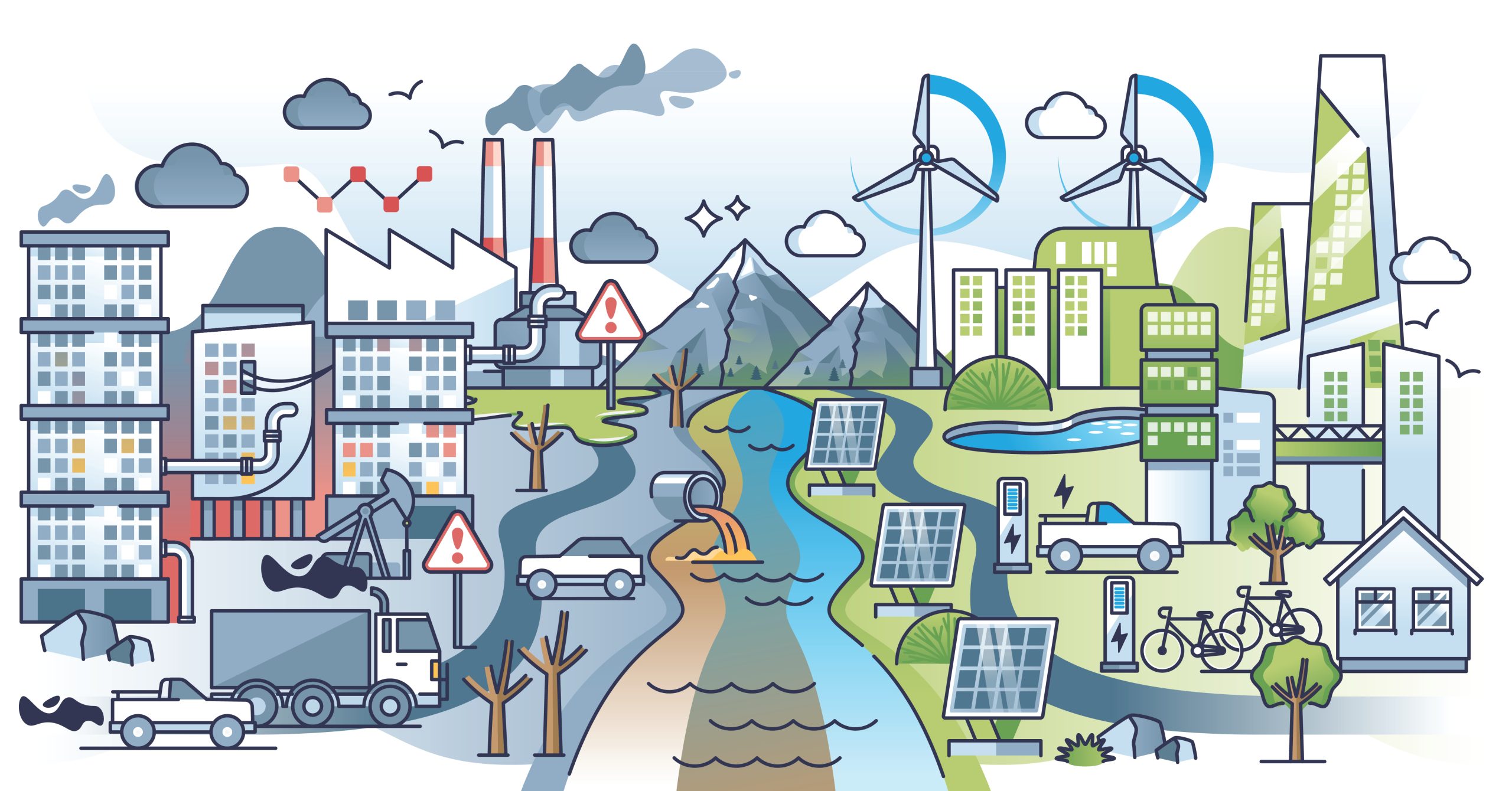
An image visually contrasting carbon-intensive industry with climate-resilient development. A central river flowing from distant mountains divides the scene into two distinct halves. The left side depicts a polluted, grey environment featuring factory smokestacks emitting dark clouds of smog, an active oil beam pump, heavy motor vehicle traffic, bare dead trees, red warning signs, and an outflow pipe discharging brown toxic waste into the left half of the river. In sharp contrast, the right side displays a clean, sustainable environment rendered in vibrant greens and blues. This side features tall wind turbines, ground-mounted solar panels, modern green buildings integrated with nature, electric vehicle charging stations, bicycles, and lush leafy trees. The right half of the river runs a clear blue, contrasting directly with the polluted water on the left, while the sky transitions from dark and smoggy on the industrial side to bright with crisp white clouds on the sustainable side. Source: Adobe Stock 714565142.

Climate resilient development

“All global modelled pathways that limit warming to 1.5°C (>50%) with no or limited overshoot, and those that limit warming to 2°C (>67%), involve rapid and deep and in most cases immediate GHG emission reductions in all sectors. Modelled mitigation strategies to achieve these reductions include transitioning from fossil fuels without CCS to very low- or zero-carbon energy sources, such as renewables or fossil fuels with CCS, demand side measures and improving efficiency, reducing non-CO2 emissions, and deploying carbon dioxide removal (CDR) methods to counterbalance residual GHG emissions.” [IPCC (2022) AR6 WGIII, Summary for Policymakers, C.3, pg. 24]